
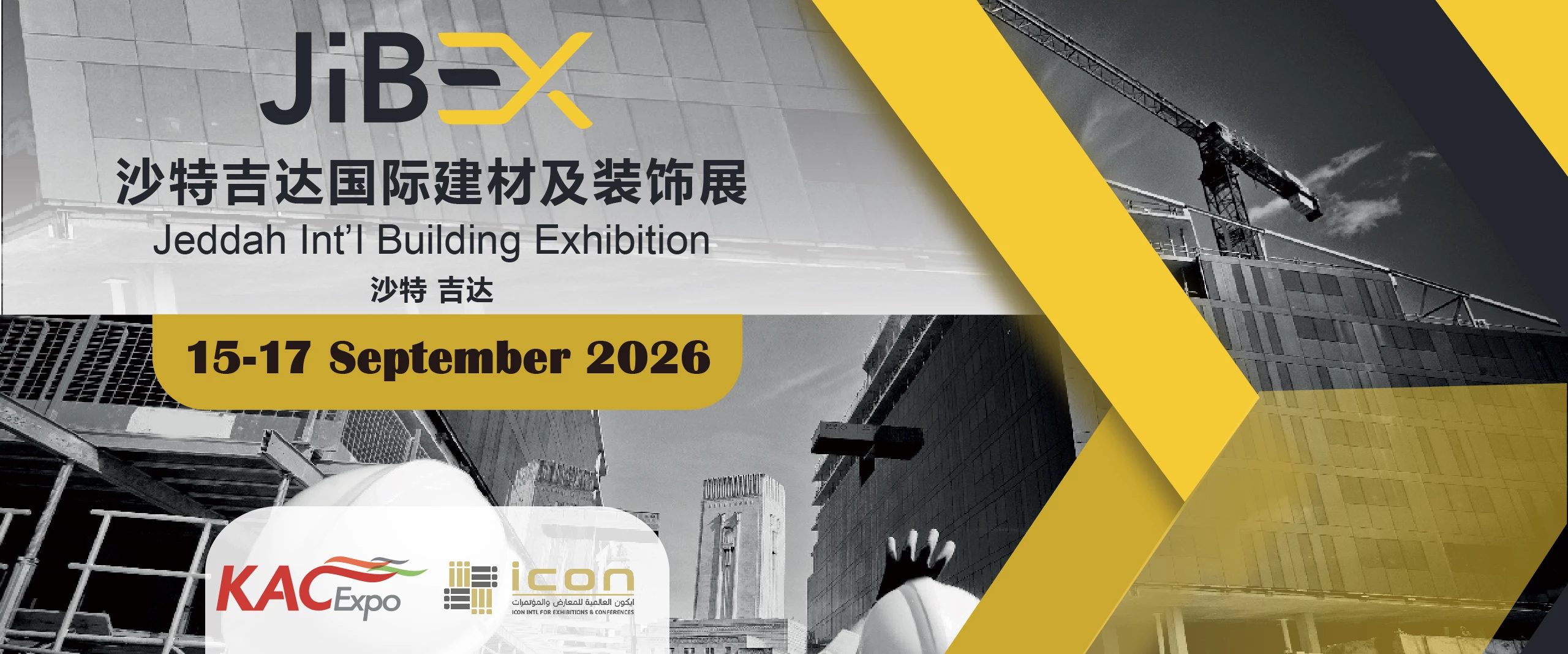
 The 35th Jeddah Int'L Building Exhibition
Exhibition time: September 15-17, 2026
Venue: Jeddah International Exhibition Center, Saudi Arabia
Host: KAC International Exhibition Group
Scope of exhibits:
1. Building materials: stone, ceramics, steel, aluminum profiles, ceramic tiles, floor carpets, artificial lawns, building panels, paving materials, wood, glass, glue, coatings, wallpaper and wall panel inlay;
2. Building materials hardware and tools: steel pipes, sanitary ware, hardware accessories, doors and windows and accessories, valves, fasteners, nail wire mesh, hardware tools, power tools, welding flux, construction site protective labor protection equipment, etc;
3. Furniture and Home Furnishings: Indoor Furniture, Outdoor Furniture, Office Furniture, Interior Decoration Materials, Courtyard Decoration, Home Decoration, Craft Home Textiles, Decorative Paintings, Camping Supplies, etc;
4. Lighting fixtures: indoor lighting, outdoor lighting, wires and cables, LED display screens, etc;
5. Kitchen and bathroom: faucets, water heaters, countertops, pipes, water meters, electricity meters, kitchenware, toilets, bathroom cabinets, shower rooms, bathtubs, etc;
6. Construction machinery: metal processing equipment, glass processing equipment, construction machinery, construction site facilities;
Project Introduction:
The Saudi International Building Materials and Decoration Exhibition has been successfully held for 34 sessions, attracting extensive professional attention and media coverage over the years. The annual exhibition has become an important procurement event for building materials buyers and related industry professionals in the Middle East region. The previous exhibition attracted over 37000 professional visitors to visit and negotiate, with a total on-site transaction volume of 83.28 million US dollars and an intended transaction volume of 278 million US dollars. The participating companies expressed high satisfaction with the exhibition results, and some companies even directly booked exhibition spots for the next exhibition on the spot. The holding of the Saudi International Building Materials and Decoration Exhibition not only promotes trade between China and Saudi Arabia in building materials and decoration products, but also lays a solid foundation for deep cooperation between China and Saudi Arabia in the field of architecture.
Introduction to Saudi Arabia:
Saudi Arabia is located on the Arabian Peninsula in southwestern Asia, covering 70% of the entire Arabian Peninsula. It borders the Persian Gulf to the east and the Red Sea to the west, and shares borders with countries such as Jordan, Iraq, Kuwait, the United Arab Emirates, Oman, Yemen, and Egypt.
In 2024, the GDP will reach 1.10 trillion US dollars, with a per capita GDP of 32738 US dollars. The Saudi Arabian currency is the Saudi riyal, with a fixed exchange rate of 1: 3.75 to the US dollar, giving it a significant trade advantage.
Saudi Arabia ranks 41st in the world in terms of population, with a total population of over 37 million by the end of 2024. 80% of the population is under the age of 40, and 70% is under the age of 30. Saudi Arabia has a strong desire and purchasing power, ranking 11th in the global retail trade index, and its consumption accounts for 70% of the total consumption in the Middle East region. There is a wide range of consumer groups, including wealthy aristocrats and the middle class, as well as ordinary people and two-thirds of the total population of migrant workers, forming three consumer groups: high, medium, and low.
The Saudi economy is an energy economy mainly based on resource extraction, with oil reserves and production ranking first in the world. Oil is the main pillar of the Saudi economy, and its manufacturing industry is very weak. Except for oil and its accessories, 95% of its materials rely on imports. It is a complementary economy to China, which has a strong manufacturing industry. China is Saudi Arabia's largest trading partner, largest exporter, and largest source of imports.
Market opportunities:
Saudi Arabia's 2030 Vision Reform Plan
In recent years, with the third generation leader of Saudi Arabia, Salman bin Salman, taking office, Saudi Arabia has begun to make bold reforms in order to build a new sustainable economy that can break away from oil dependence. We aim to build Saudi Arabia into the heart of the Arab and Muslim world, a world economic powerhouse for global investment, and a global hub connecting Asia, Europe, and Africa in future development, and have announced the "2030 Vision Plan". This vision plan encompasses goals in multiple fields, including infrastructure, energy, economy, society, and culture. Saudi Arabia is changing the global business landscape and attracting global traffic through massive investments.
In terms of infrastructure, Saudi Arabia is investing trillions of dollars to build super projects such as TheLine, NEOM New City, Mukaab Building, Qiddiya Entertainment City, and the kilometer high Kingdom Tower, which have attracted worldwide attention.
In addition, Saudi Arabia currently has a total of 167 registered hotels under construction, with a total of 63753 guest rooms. At the same time, commercial residential buildings and supporting living facilities are also being built in large quantities, and large-scale infrastructure activities have brought huge demand, including the demand for hardware and building materials, interior decoration, home appliances, daily consumer goods and other commodities in the market. Moreover, with the increasingly close relationship between China and Saudi Arabia in recent years, Saudi Arabia has gradually abandoned its previous import channels from Europe and America, and turned to more cost-effective Chinese products. The large gap left by European and American products needs to be filled by more Chinese products. China has become Saudi Arabia's largest trading partner, its largest source of imports and export target country.
In the socio-cultural field, Saudi Arabia actively hosts world-class events and events to enhance its global influence. In 2023, Saudi Arabia successfully hosted the Formula World Championship Saudi Grand Prix and Saudi Club World Cup. In the future, Saudi Arabia will also host a series of large-scale events such as the World Cup, Asian Cup, World Expo, Asian Summer Games, Asian Winter Games, and F1 racing. The hosting of these international events will attract travelers from all over the world, further enhancing consumer demand and retail market share, bringing huge business opportunities to the future market.
Jeddah, as the second largest city in Saudi Arabia and a port city along the Red Sea coast, is the residence of the government's Ministry of Foreign Affairs and embassies of various countries. It has the largest port in Saudi Arabia and is an extremely important financial center. At the same time, because Jeddah is only 70 kilometers away from the holy city of Mecca, a global tourist destination for 1.8 billion Muslims, it is also the most important tourist city in Saudi Arabia. As the economic and trade center of Saudi Arabia, with the advancement of Saudi reform and opening up, Jeddah's trade prospects will surpass Dubai and become the largest trading market in the Middle East. Compared to the Dubai market, which has a small market size and mainly focuses on low-priced transshipment, the local terminal market in Saudi Arabia has a great advantage in terms of large volume and high prices, providing significant profit guarantees for China's foreign trade enterprises.
Diplomatic relations between the two countries:
In recent years, the development of China Saudi Arabia relations has shown three hotspots: high-level exchanges, economic and trade cooperation, and cultural exchanges. With the steady progress of the the Belt and Road Initiative, Saudi Arabia actively responds to China's call. China and Saudi Arabia are each other's strategic partners at the national level, and their diplomatic relations are stable. In December 2023, President Xi Jinping paid a state visit to Saudi Arabia. During the visit, the two heads of state personally signed the Comprehensive Strategic Partnership Agreement between the People's Republic of China and the Kingdom of Saudi Arabia, agreeing to hold a summit between the two countries every two years.
In March 2023, with the assistance of China, Saudi Arabia and Iran reached an agreement to restore diplomatic relations. On March 29 of the same year, the Saudi Arabian Cabinet approved the decision to join the Shanghai Cooperation Organization. In November 2023, the People's Bank of China and the Central Bank of Saudi Arabia signed a bilateral local currency swap agreement, which indicates that China Saudi Arabia trade has entered a new stage and is another milestone of China Saudi Arabia trade. Under the guidance of national strategy, China and Saudi Arabia have engaged in comprehensive cooperation in military, economic, cultural, scientific, and sociological fields, reflecting the close and stable strategic partnership between the two countries and laying a solid foundation for future cooperation.
In October 2024, the Saudi government announced the construction of a four square kilometer Saudi China Special Economic Zone within King Salman International Airport. The economic zone will be jointly constructed by King Salman International Airport and international investment institution Yida Capital, with a focus on developing manufacturing, logistics, and trade industries to promote economic and trade cooperation between Saudi Arabia and China.
