
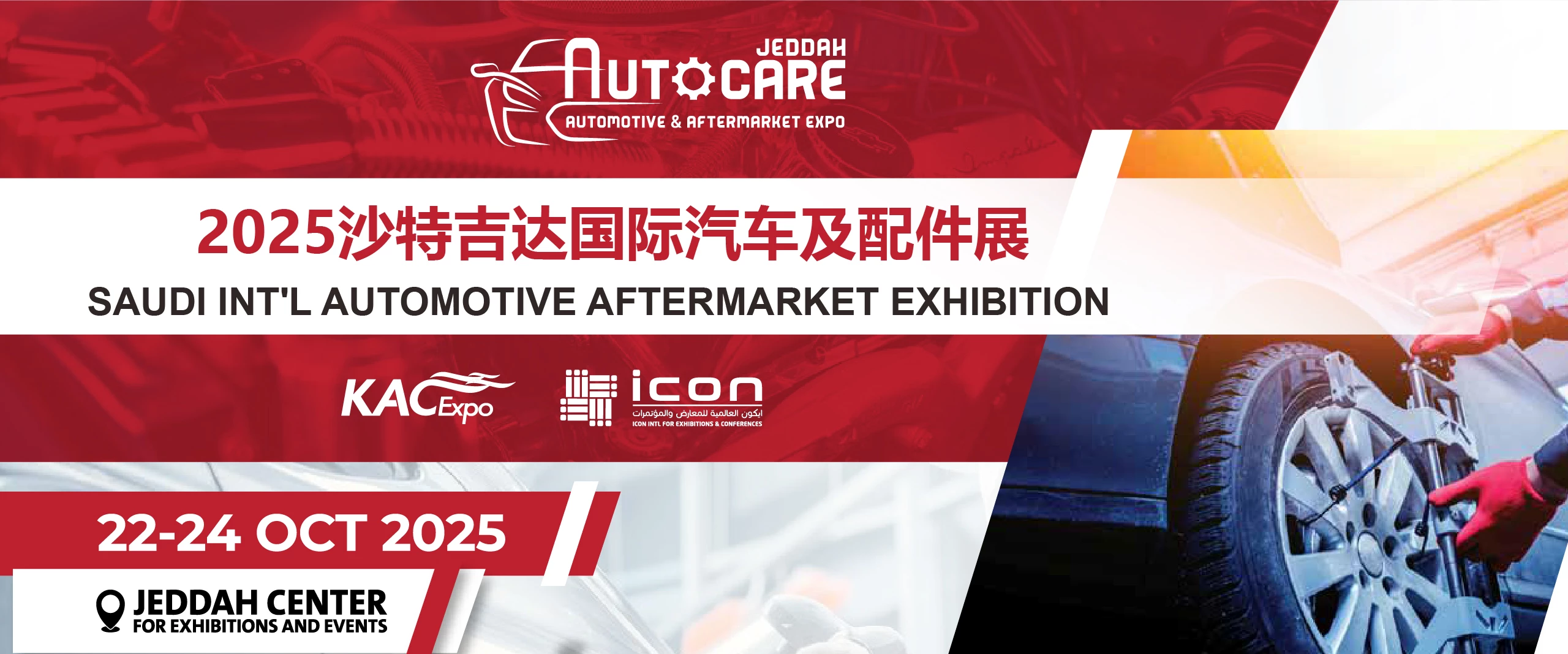
The 16th Saudi Int’l Automotive Aftermarket Exhibition(Saudi Autocare)
Exhibition time: October 22-24, 2025
Venue: Jeddah International Exhibition Center, Saudi Arabia
Host: KAC International Exhibition Group
Scope of exhibits:
1. Whole vehicle: various sedans, off-road vehicles, construction vehicles, special vehicles, transport vehicles, trailers, concept cars, high-performance racing cars, luxury cars and other vehicles;
2. Automotive components and devices: various parts and OEMs, drive parts, chassis, body, automotive batteries, internal devices and components, automotive power and electronic control systems, motors and electrical appliances, vehicle lighting, electronic systems,
Comfort electronic products, etc;
3. Automotive parts and modified vehicles: vehicle parts, special equipment, modified vehicles, performance testing systems, etc;
4. Tire Zone: Tires, wheel hubs, tire repairs, tire management systems, tire sales and storage equipment, etc;
5. Maintenance: vehicle service and repair equipment, vehicle body maintenance, vehicle body painting, garage construction and management, etc;
6. Automotive services and cleaning stations: automotive services, maintenance and cleaning equipment, vehicle refurbishment, gas station equipment, etc.
Project Introduction:
The Jeddah International Auto and Parts Exhibition in Saudi Arabia is held once a year, with an exhibition area of 15000 square meters. In the past 15 exhibitions, the exhibition has attracted many buyers from Middle Eastern countries such as Saudi Arabia, the United Arab Emirates, Egypt, Jordan, and Iraq due to its professionalism and extensive influence, becoming an annual must visit event for Middle Eastern industry professionals. This exhibition not only showcases the latest automobiles, automotive parts, maintenance equipment, and technologies, but also provides a platform for exhibitors and buyers to communicate and cooperate, effectively promoting the expansion of exhibitors' business and the establishment of cooperative relationships. Saudi Arabia, as one of the more populous countries in the Middle East, has underdeveloped public transportation and low oil prices, resulting in the region having the highest per capita car ownership rate in the world. According to statistics, the annual consumption of automobiles and related industries in the Middle East exceeds 15 billion US dollars. This vast consumer market provides enormous business opportunities and development space for the automotive parts industry.
Introduction to Saudi Arabia:
Saudi Arabia is located on the Arabian Peninsula in southwestern Asia, covering 70% of the entire Arabian Peninsula. It borders the Persian Gulf to the east and the Red Sea to the west, and shares borders with countries such as Jordan, Iraq, Kuwait, the United Arab Emirates, Oman, Yemen, and Egypt.
In 2024, the GDP will reach 1.10 trillion US dollars, with a per capita GDP of 32738 US dollars. The Saudi Arabian currency is the Saudi riyal, with a fixed exchange rate of 1: 3.75 to the US dollar, giving it a significant trade advantage.
Saudi Arabia ranks 41st in the world in terms of population, with a total population of over 37 million by the end of 2024. 80% of the population is under the age of 40, and 70% is under the age of 30. Saudi Arabia has a strong desire and purchasing power, ranking 11th in the global retail trade index, and its consumption accounts for 70% of the total consumption in the Middle East region. The consumption level is relatively broad,
There are three consumer groups: high, middle, and low, consisting of wealthy nobles and middle-class individuals, as well as ordinary people and two-thirds of the total population consisting of migrant workers.
The Saudi economy is an energy economy mainly based on resource extraction, with oil reserves and production ranking first in the world. Oil is the main pillar of the Saudi economy, and its manufacturing industry is very weak. Apart from oil and its accessories,
95% of goods rely on imports, and China, with its strong manufacturing industry, is a complementary economy. China is Saudi Arabia's largest trading partner, largest exporter, and largest source of imports.
Market opportunities:
Saudi Arabia's 2030 Vision Reform Plan
In recent years, with the third generation leader of Saudi Arabia, Salman bin Salman, taking office, Saudi Arabia has begun to make bold reforms in order to build a new sustainable economy that can break away from oil dependence. We aim to build Saudi Arabia into the heart of the Arab and Muslim world, a world economic powerhouse for global investment, and a global hub connecting Asia, Europe, and Africa in future development, and have announced the "2030 Vision Plan". This vision plan encompasses goals in multiple fields, including infrastructure, energy, economy, society, and culture. Saudi Arabia is changing the global business landscape and attracting global traffic through massive investments.
Saudi Arabia is one of the largest automobile markets in the Middle East, and with the increasing income level of residents and the gradual popularization of automobile culture, the demand for automobiles continues to grow. According to market research, Saudi Arabia's annual car sales are expected to grow at a rate of approximately 5% per year. The younger consumer group's demand for new car models and high-tech configurations also provides abundant market opportunities for automotive companies.
At the same time, the Saudi government has launched a series of preferential policies to promote the transformation of its economy and attract foreign investment in the automotive modification manufacturing industry. Saudi Arabia hopes to enhance the country's industrial level by increasing local manufacturing capabilities and technology transfer. This provides a favorable trade environment and policy support for Chinese automobile and spare parts enterprises.
Chinese automobile companies are rapidly developing technologies in areas such as electric vehicles and intelligent driving, which can meet the demand for emerging technologies in the Saudi market. In recent years, brands such as BYD and NIO have begun to enter the Middle East market and have gained a certain market share. Saudi Arabia's emphasis on environmental protection and reducing carbon emissions has further promoted the construction of electric vehicles and related infrastructure, providing a broad market space for Chinese electric vehicle companies.
Jeddah, as the second largest city in Saudi Arabia and a port city along the Red Sea coast, is the residence of the government's Ministry of Foreign Affairs and embassies of various countries. It has the largest port in Saudi Arabia and is an extremely important financial center. At the same time, because Jeddah is only 70 kilometers away from the holy city of Mecca, a global tourist destination for 1.8 billion Muslims, it is also the most important tourist city in Saudi Arabia. As the economic and trade center of Saudi Arabia, with the advancement of Saudi reform and opening up, Jeddah's trade prospects will surpass Dubai and become the largest trading market in the Middle East. Compared to the Dubai market, which has a small market size and mainly focuses on low-priced transshipment, the local terminal market in Saudi Arabia has a great advantage in terms of large volume and high prices, providing significant profit guarantees for China's foreign trade enterprises.
Diplomatic relations between the two countries:
In recent years, the development of China Saudi Arabia relations has shown three hotspots: high-level exchanges, economic and trade cooperation, and cultural exchanges. With the steady progress of the the Belt and Road Initiative, Saudi Arabia actively responds to China's call. China and Saudi Arabia are each other's strategic partners at the national level, and their diplomatic relations are stable. In December 2023, President Xi Jinping paid a state visit to Saudi Arabia. During the visit, the two heads of state personally signed the Comprehensive Strategic Partnership Agreement between the People's Republic of China and the Kingdom of Saudi Arabia, agreeing to hold a summit between the two countries every two years. In March 2023, with the assistance of China, Saudi Arabia and Iran reached an agreement to restore diplomatic relations. On March 29 of the same year, the Saudi Arabian Cabinet approved the decision to join the Shanghai Cooperation Organization. In November 2023, the People's Bank of China and the Central Bank of Saudi Arabia signed a bilateral local currency swap agreement, which indicates that China Saudi Arabia trade has entered a new stage and is another milestone of China Saudi Arabia trade. Under the guidance of national strategy, China and Saudi Arabia have engaged in comprehensive cooperation in military, economic, cultural, scientific, and sociological fields, reflecting the close and stable strategic partnership between the two countries and laying a solid foundation for future cooperation. I believe that with the joint efforts of both sides, China Saudi Arabia cooperation will usher in more and deeper development.
In October 2024, the Saudi government announced the construction of a four square kilometer Saudi Central Special Economic Zone within King Salman International Airport. The economic zone will be jointly constructed by King Salman International Airport and international investment institution Yida Capital, with a focus on developing manufacturing, logistics, and trade industries to promote economic and trade cooperation between China and Saudi Arabia.
