
Amid ongoing tensions in the Strait of Hormuz, global energy and cargo transportation face heightened uncertainty. As one of the world’s most vital oil transit corridors, every fluctuation in the Strait of Hormuz sends ripples across the international shipping market.
Against this backdrop, Saudi Arabia’s Ports Authority (Mawani) announced on Monday the launch of five new international maritime services in partnership with global shipping giants including MSC, CMA CGM, Maersk, and Hapag-Lloyd, strengthening the Red Sea’s role as a pivotal logistics hub. This is more than just a simple expansion of shipping routes—it is a strategic move by Saudi Arabia to take the initiative amid shifts in the global supply chain.
The Strait of Hormuz: A Chokepoint for Global Maritime Shipping
Located between Oman and Iran, the Strait of Hormuz connects the Persian Gulf and the Arabian Sea, with a narrowest width of just approximately 39 kilometers. It is the world’s most critical oil transit route, handling around 20% of global crude oil trade and 25% of liquefied natural gas (LNG) trade.
A forced closure or severe disruption to the strait would trigger immediate consequences across the globe:
- Energy supply disruption risks: Oil exports from Gulf states (Saudi Arabia, the UAE, Kuwait, Qatar, etc.) would be forced to seek alternative channels, which cannot be fully diverted in the short term, potentially causing sharp volatility in international oil prices.
- Surge in global shipping costs: Vessels would be forced to reroute via the Cape of Good Hope or redesign their itineraries, drastically extending voyages and driving up freight and insurance costs, which would ultimately pass through to global trade expenses.
- Extended supply chain timelines: Major container routes between East Asia–Europe and East Asia–the Middle East would face severe delays, disrupting inventory turnover for manufacturing and retail industries.
- Restructuring of regional logistics systems: Transshipment and warehousing networks reliant on Persian Gulf ports (such as Dubai’s Jebel Ali Port and Dammam Port) would come under immense pressure, forcing neighboring ports to explore alternative solutions.
It is precisely these geopolitical risks that have driven Saudi Arabia to ramp up investment in Red Sea coastal ports in recent years, aiming to build a more resilient international trade corridor outside the Persian Gulf.
Saudi Arabia’s Response: Leveraging Red Sea Hubs to Mitigate Hormuz Risks
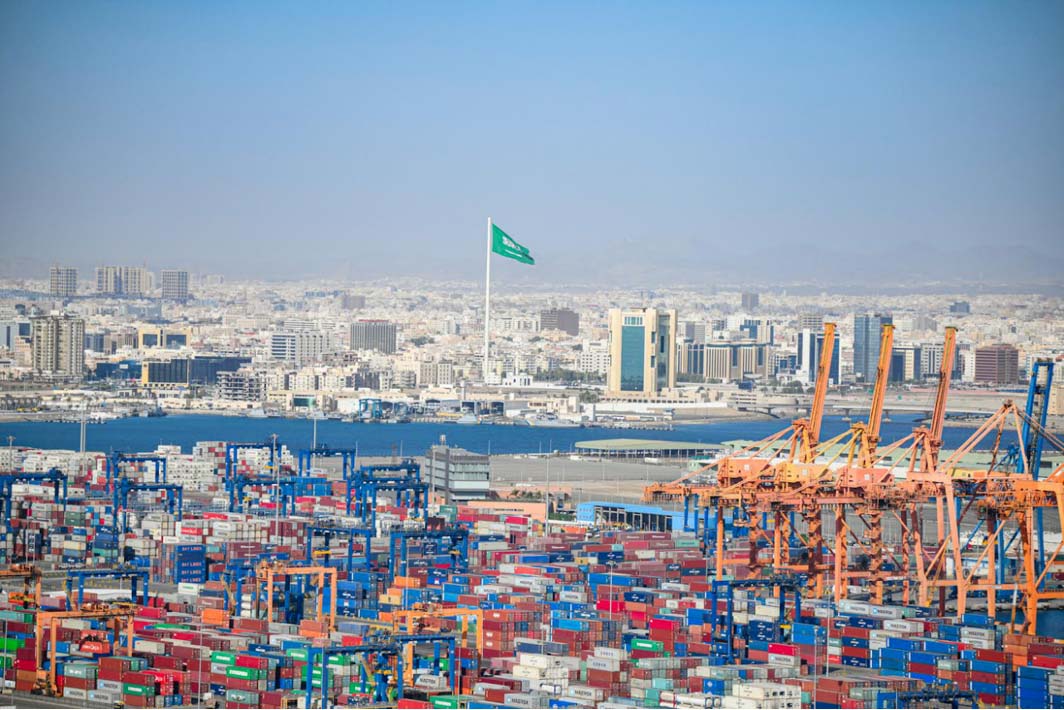
Rather than waiting passively for uncertainties in the Strait of Hormuz to ease, Saudi Arabia is proactively building alternative corridors—positioning Red Sea hubs such as Jeddah Islamic Port and King Abdullah Port as strategic pivots capable of absorbing cargo diverted from the Persian Gulf.
The five newly launched routes embody the full implementation of this strategy.
Five New Routes Operational: Building a Dual Logistics Corridor
In collaboration with global shipping leaders MSC, CMA CGM, Maersk, and Hapag-Lloyd, Saudi Arabia’s Ports Authority has rolled out five new routes with a total handling capacity of over 63,000 TEUs, significantly boosting operational efficiency and route coverage for Saudi ports.
- GULF SHUTTLE (operated by MSC)
Focused on intra-Gulf connectivity, the service calls at Dammam, Sharjah, Abu Dhabi, and Umm Qasr. It strengthens short-sea feeder networks between Saudi Arabia and other Gulf states, maintaining logistical resilience within the Persian Gulf region.
- REDEX (operated by CMA CGM)
A Red Sea–Mediterranean express route, it tightly links Jeddah with Alexandria, Damietta, Aqaba, Tangier, Algeciras, and the Malta Freeport, opening a fast corridor from the Red Sea to Europe and North Africa and offering greater flexibility for regional trade.
- JADE (operated by Hapag-Lloyd)
Directly serving King Abdullah Port and Jeddah Islamic Port, the route connects major Asian ports including Busan, Ningbo, Shanghai, and Shekou, extending to key Mediterranean hubs such as Iskenderun, Trieste, Koper, and Mersin. It further enhances direct connectivity between the Red Sea and the Mediterranean.
- AE19 (operated by Maersk)
Covering major Chinese ports including Tianjin Xingang, Qingdao, Ningbo, and Shanghai, the route transships via Tanjung Pelepas, connects Western and Eastern Mediterranean hubs, terminates at Jeddah, and returns via the Eastern Mediterranean. It provides an alternative path for cargo between East Asia and Europe that bypasses the Strait of Hormuz.
- SE4 (jointly operated by Maersk and Hapag-Lloyd)
Following a similar rotation to AE19, the route covers Tianjin Xingang, Qingdao, Ningbo, Shanghai, Tanjung Pelepas, Western Mediterranean hubs, Eastern Mediterranean hubs, and Jeddah. Together with AE19, it forms a dual artery linking East Asia–the Mediterranean–Jeddah.
Beyond Shipping Routes: A Trade Bridge to Boost Land-Sea Connectivity
In addition to expanding maritime routes, Saudi Arabia’s Ports Authority has unveiled an even more strategically visionary land-based initiative: the construction of a trade bridge connecting Sharjah and the Kingdom of Saudi Arabia.
This move aims to enhance land-sea connectivity in the Red Sea region and further mitigate geopolitical risks facing critical maritime chokepoints like the Strait of Hormuz. By deeply integrating Red Sea port resources, Saudi Arabia is establishing a backup plan that ensures stable cargo flow even if the Strait of Hormuz is disrupted.
Conclusion
Tensions in the Strait of Hormuz represent a test of resilience for the global supply chain. Saudi Arabia’s response, however, is not passive waiting for de-escalation, but proactive construction of a more robust international trade corridor centered on Red Sea hubs—through new shipping routes, a dedicated trade bridge, and deepened partnerships with global shipping leaders.
From Jeddah Port’s 62 berths and 130 million-ton annual handling capacity to the newly launched 63,000-TEU route network, Saudi Arabia is accelerating its transformation from an oil powerhouse to a global logistics hub. For businesses engaged in international trade, shipping, and the Middle East market, these developments translate to greater transport options and enhanced supply chain security.
The value of the Red Sea as a "golden waterway" is being redefined.
